Showing posts with label #history. Show all posts

Wednesday, May 1, 2019

Heroin and opioids in the UK

A PhD dissertation from the London School: 
Link to online PDF

Hallam, Chris (2016) Script Doctors and Vicious Addicts: Subcultures, Drugs, and Regulation under the ’British System’, c.1917 to c.1960. PhD thesis, London School of Hygiene & Tropical Medicine. DOI: https://doi.org/10.17037/PUBS.03141178
Downloaded from: http://researchonline.lshtm.ac.uk/3141178/ DOI: 10.17037/PUBS.03141178

Friday, November 9, 2018

Cannabis files

You might have thought liberalization of cannabis policies was something new.

Think otherwise.

Wednesday, October 10, 2018

Legal History of Psychoactive Drugs (Footnote on ‘Company Law’)

Article on the concept of a ‘company’ as is pertinent in the history of drug regulation.

There are some interesting historical details about British regulation of companies in this work.
If you see a corresponding American perspective, please add it as a comment.


Thursday, October 4, 2018

Cannabis images to spice up your lectures on stigma-laden and racist drug propaganda

Simply do a web browser search for: locoweed mexican carlotta

Illustrations of what you will find:


Selwyn D. Collins

Worked with Sydenstricker and Frost.
Studies of lifetime history of illness, using logistic curve learned from Raymond Pearl.


Tuesday, August 28, 2018

Hollerith, Billings, and the 1890 US Census

A note on Hollerith: https://en.wikipedia.org/wiki/Herman_Hollerith . Reading it, I learned another connectivity lesson. Hollerith worked for John Shaw Billings, whose name I recognized as someone connected to Hopkins who had worked out Vital Statistics for the US Censuses in the 19th century. Apparently it was Billings who urged Hollerith to develop the punch card approach for the US Census of 1890. That census report is remarkable in that it apparently no longer exists (due to a fire and perhaps to some neglect). This is too bad because it included questions on disablement of household members and counted those affected by life-long cognitive problems (‘idiots’) and with other problems.


https://www.archives.gov/publications/prologue/1996/spring/1890-census-1.html

Sunday, August 19, 2018

Martin I. Wilbert and Murray G. Motter, ‘Pioneer’ Drug Dependence Epidemiologists Responsible for Initial USPHS(NIH) Contributions to Our Field

Few scientists or practitioners in our field know about the United States Public Health Service “Laboratory of Hygiene” set up on Staten Island, New York, in 1887 with Dr. Joseph J. Kinyoun, Marine Hospital Service physician-bacteriologist, at the helm, and with a scientific staff restricted to medically trained physicians. The history of the US National Institutes of Health traces its roots back to this Hygienic Laboratory and indicates that the laboratory was moved to Washington, D.C., in 1891. In 1902 the laboratory received an appropriation that expanded its mission and allowed employment of non-physician scientists (https://history.nih.gov/exhibits/history/index.html)


Photo of JJ Kinyoun as a younger man, and Laboratory of Hygiene colleagues:


[Attribution-NonCommercial-ShareAlike 3.0 (CC BY-NC-SA 3.0 US)].


Photo of oil portrait of JJ Kinyoun as an older man:


CC BY-NC-SA 3.0 (US)


In the 1902 appropriation, the US Congress allowed the Hygienic Laboratory to expand and include new Divisions, including a Division of Pharmacology. The staffing restriction was removed to permit employment of non-MD scientists as professional staff members (https://history.nih.gov/exhibits/history/docs/page_02.html). Two of these scientists were Martin Inventius Wilbert, Phar.D., and Murray Galt Motter, who together became responsible for what appear to be the first US Public Health Service and possibly the first NIH contributions to the epidemiological study of the now-internationally regulated drugs (IRD) formerly mis-labeled as ‘narcotic drugs’ and including compounds as diverse as cocaine, cannabis, and opium.

< URL to link to the following article >


This is the earliest of Motter’s contributions I’ve been able to find:

< URL link to Motter, 1915 >


The earliest of Wilbert’s ‘firsts’ I’ve been able to find:

The elimination of the nostrum traffic, an evident duty of American physicians
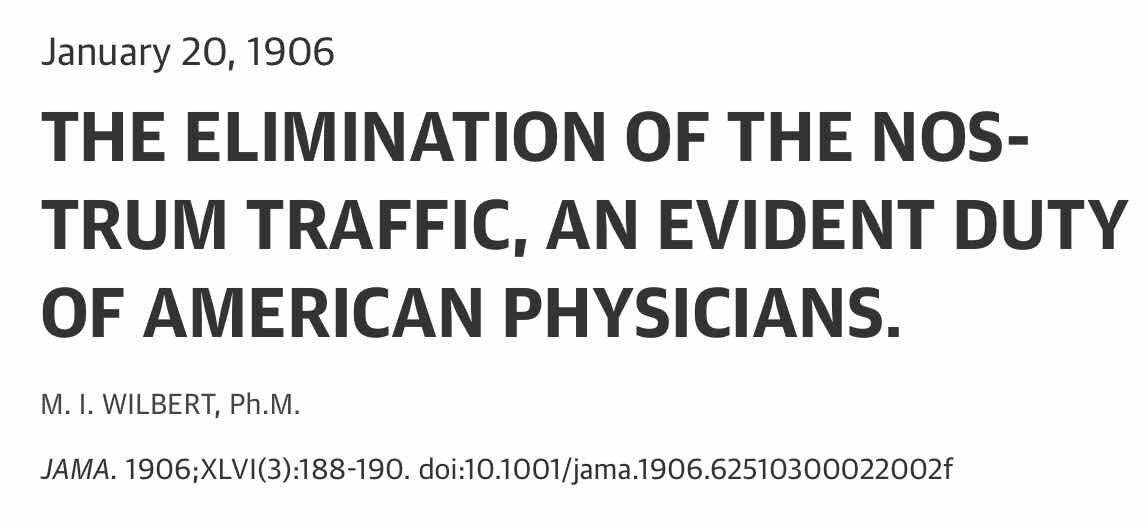


 The record of Wilbert’s USPHS/(NIH) ‘firsts’ of this type also appears to be an initial early note in ‘occupational epidemiology’ or ‘occupational toxicology’ which concerning occupational intoxications:


Photo of MI Wilbert as a young adult. This photo accompanied his obituary in 1916, cited below:


Wilbert’s contributions were not limited strictly to pharmacology. They also covered legal issues, preventive medicine, and public health initiatives in the domain of prevention:
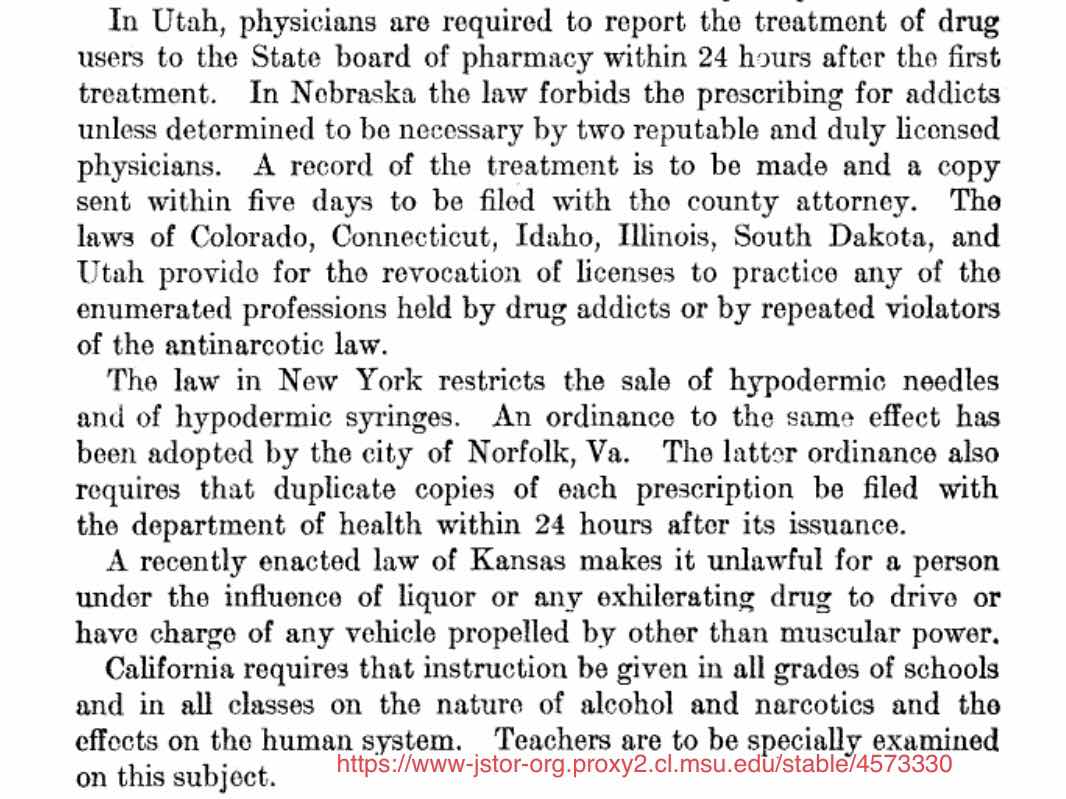


JSTOR link to this article from 1916.


D. Burkholder wrote a historical note about Wilbert, and published it in the American Journal of Hospital Pharmacy in 1968.

A Wilbert obituary was written in 1916 by George McCoy, who was then the Director of the laboratory.


< URL to link to the following article >

As is regrettably true for some contemporary epidemiologists and practitioners in our field, Wilbert sometimes used hyperbolic language and went ‘over the top’ in a fashion that tends to heap stigma upon affected individuals. Alas!


Sunday, October 22, 2017

Balfour's Neuroepidemiology of 1845

Balfour JSTOR URL. Look for diseases of the brain in naval versus military (ground forces).


Tuesday, October 3, 2017

Emergence of drug development after Dalton's atomic theory

Professor Tom Ban just contributed a useful short essay on the background of neuropsychopharmacology, with some details that embellish what I've described in relation to Woods' first use of a syringe to inject morphine for pain relief and the emergence of drug development from the aniline dye industries.


For more on John Dalton, this 43 minute podcast is instructive: In Our Time
In Our Time

More from BBC:


Why would someone like Perkin want to synthesize quinine?
Why do the people of Peru jealously guard their supply of quinoa?


"What is Quinine

The story is that Spanish colonists discovered that the bark from the Quinquina tree in Peru could be used to treat Malaria. This likely happened in the early 1600’s. In Europe this ground bitter bark became known as Fever Tree bark or Jesuit’s powder. It is believed that the discovery and usage of the bark was one of the reasons why European countries managed to colonize the tropics.

The most active ingredient in the bark is quinine. In 1817 a couple of French scientists discovered a way to extract the quinine from the bark and from then on pure quinine powder became available to prevent the Malaria. It was this powder that was prescribed to the British officers which they created the first Tonic water with.

In the beginning most bark for quinine came from its original country of Peru. But seeds was smuggled out in 1860 and was sold to the Dutch government. They set up big plantations in Java, Indonesia where they could have full control of the market. During World War II the Japanese occupied Java which lead to a shortage in quinine. To prevent this from being a future problem trees was planted in Africa and synthetic quinine was developed.

Both the planting in Africa and the creation of synthetic quinine turned out successful and now there are quinine exported from Africa as well as synthetic quinine."

Saturday, September 9, 2017

The Emergence of the Modern Scientific Method

Some of you have asked about the approach of direct experience and observation leading to potential lawful relationships, and then these laws (theories) forming particular predictions (hypotheses), and then subjecting these predictions to mathematical evaluation.

I found this book, available to us on JSTOR, to be useful.
These chapters and the work of Roger Bacon, an apparent student of a Robert Grosseteste at Oxford, describe crucial developments:


There is a BBC4 podcast on the life of Bacon if you get tired of reading after Chapter 3:

Roger Bacon podcast